
CS2 Skin Gambling: The House Edge Starts Before You Bet
CS2 Skin Gambling: The House Edge Starts Before You Bet
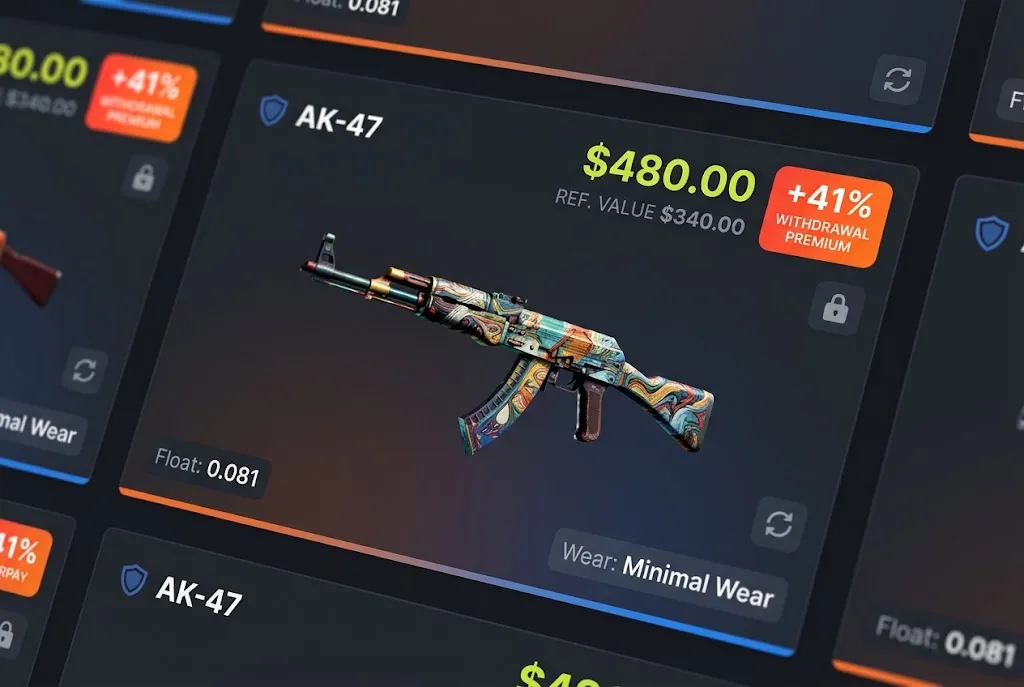
A StatTrak M4A4 Howl in Factory New sits on the 500 Casino marketplace at $15,778.25 with a +15% tag next to it. An AK-47 Wild Lotus Factory New is listed at $14,962.30 with +16%. The marketplace has a filter at the top for maximum modifier, and the default cap is 20%.
That modifier is the premium over reference price. On the Howl, 15% works out to roughly $2,058 above where the item would otherwise be valued. You have not placed a bet yet. You have simply chosen to take your balance out as a skin rather than as crypto, and it has cost you two grand.
That’s the part of skin gambling nobody writes about, because everyone is too busy arguing about whether the roulette wheel is rigged.
What is CS2 skin gambling?
CS2 skin gambling is betting with Counter-Strike 2 weapon skins instead of cash. You transfer skins from your Steam inventory to a third-party site, they credit your account with a balance, and you play casino games with it: roulette, crash, dice, coinflip, or case opening.
Two things make it different from a normal crypto casino. The chips are items Valve created and controls, and the deposit arrives through Steam’s trading system rather than a payment processor.
The sites split into a few types. Skin casinos run house games and accept skins as deposits. Case-opening sites sell their own cases containing real skins, at odds they set themselves. Case battle sites let players open the same cases simultaneously and the higher total takes everything. Most of the bigger operations do all three.
Does Valve allow skin gambling?
No, and it never has. Valve’s position has been public since 13 July 2016, when it stated that using the OpenID API and making the same web calls as Steam users to run a gambling business is not permitted under its API or user agreements, and said it would send notices to those sites. It sent cease and desist letters to 23 operators that month.
In 2018 it added a 7-day trade hold, which killed instant deposit and withdrawal and forced the whole market to restructure around it. It has also periodically disabled bot accounts tied to trading and gambling platforms.
None of that stopped anything. By 2016 an estimated $5 billion in skins had already been wagered on third-party sites, and the market rebuilt itself around every restriction Valve added. The reason is simple: as long as players can trade with each other, a site can position itself as the other player.
The practical risk this leaves you with is on your Steam account, not your casino account. Commercial use of Steam accounts breaches the Subscriber Agreement, and trade restrictions mean losing access to the entire inventory, not just the skin you were moving.
Valve controls the chips and the money supply
Here’s the part that reframes the whole thing. Before any third-party site touches your money, the official case system has already taken a large bite, and Valve publishes exactly how large.
| Rarity | Drop rate | Roughly one in |
|---|---|---|
| Mil-Spec (blue) | 79.92% | 1.25 |
| Restricted (purple) | 15.98% | 6 |
| Classified (pink) | 3.20% | 31 |
| Covert (red) | 0.64% | 156 |
| Knife or gloves (gold) | 0.26% | 385 |
Those are Valve’s own disclosed numbers, published in 2017 under Chinese loot box rules and unchanged since, including through the move to CS2.
Work the knife number. At 0.26%, the average is one gold item per 385 cases. A key costs $2.49, so that’s roughly $958 in keys alone before you count the cases themselves. And because each open is independent with no pity timer, more than a third of players who open 385 cases still have nothing gold to show for it.
Independent analyses put the average monetary return on official case opening somewhere between 50% and 70% of spend. Then Steam takes around 15% when you sell on the Community Market.
So the game publisher runs a product with a 30% to 50% expected loss, sets the drop rates, prints the items, and charges a fee on every resale. Third-party gambling sites are not an alternative to that house. They’re a second house built on top of it.
Which CS2 gambling sites are actually licensed?
Very few, and this is the single most useful thing to check before you deposit.
500 Casino is one of the ones that has a licence you can look up. It’s operated by Perfect Storm B.V, Curaçao registration number 150536, licensed by the Curaçao Gaming Control Board under OGL/2024/1354/0882, with payments and operational support handled by Nine Yards Limited of Limassol, Cyprus, company number HE407807. It publishes an AML and KYC policy and a responsible gaming page, and the Fairness and XP Calculator pages are in the site footer rather than buried.
Compare that to the broad field. Independent comparisons of 43 CS2 and CSGO gambling sites found a large share with no licence stated at all, and several operating as relaunches of brands Valve named in 2016. Some don’t publish odds. Some don’t publish who owns them.
A Curaçao licence under the new Gaming Control Board regime is not the UK Gambling Commission. It doesn’t give you a player funds protection rating, and the complaints process is thinner than a European licensee’s. It does give you a named operating company, a registration number, a regulator that exists, and somewhere to send a complaint that isn’t a Discord server. In this corner of the market that’s a meaningful gap rather than a small one.
What should you actually check before depositing skins?
Read the odds table on the specific case, not the site’s general fairness page. Third-party case odds vary per case and are set by whoever built it.
Check who built the case. On 500 Casino the Case Creator lets any user assemble a case, pick items, and set odds that must total 100% before the price is calculated. The user-generated section is full of cases with names like “100% PROFIT” at $0.46, “money maker 2000 case” at $0.84, and “IF IT WAS SO EASY EVERYONE WOULD BE DOING IT” at $4.57. Several carry a streamer’s referral code in the case name itself, such as “USE CODE D0KT0R3N” at $98.16. The odds are published, which is more than most platforms manage, but you’re opening a product designed by someone who earns when you open it.
Look at who’s in your case battle. On 19 October 2026 every active battle in the lobby, 25 rounds of a $126.17 case each, was listed as Anonymous against three bots with names like BOT Fred, BOT Newton and BOT Powersl1de. Battles against bots are a house game with extra steps, and the site is upfront about labelling them, but a lot of players read “battle” and assume a human lost.
Check the modifier before you withdraw in skins. That 15% to 20% premium is the real cost of cashing out as an item rather than a coin. Not everything carries one: a Natus Vincere Holo Katowice 2014 sticker was listed at $9,700 with a -12% tag the same day, so below-reference listings exist. You have to look.
And read the Steam Trade Protection note. 500 Casino holds skin deposit funds until the trade is irreversibly complete, and warns that an unreasonable revert can mean a fee and suspension from the marketplace. That’s Steam’s hold, not the site’s invention, but it’s your skin sitting in limbo either way.
The loop nobody puts in the responsible gambling page
The chat window is part of the product. Watching the public room on 19 October, a player described accidentally putting 3,000 on grey on the Wheel of Fortune while trying to clear $0.50 of Solana, hitting it for around 6,000, and saying it was worth more than three of his paychecks. The chat response was not “cash out”. It was that three more bets on grey would get him to level 600, that he’d probably end up putting 6,000 on black, and that he should skip work. He said he was too lazy to cash it out right then.
Nothing there is unusual and nothing there was the operator’s doing. It is, though, exactly the mechanism the level system is built to feed. The site runs an XP ladder, a VIP club, and daily and weekly Royales with $20,000 and $100,000 prize pools. Players carry their level next to their name in chat, which means your position in the ladder is a public number other people comment on. Deposit limits and self-exclusion tools exist on licensed sites like this one. Nothing in the interface is designed to point you at them.
The age gap
Steam’s minimum age is 13. Licensed gambling sites are 18 and verify it. Everything between those two numbers is the problem, and it sits almost entirely with the unlicensed end of the market, where a Steam login is the whole signup process and nobody asks for a document.
A 15-year-old can’t open an account at a KYC-enforcing operator. He can absolutely open a Steam account, accumulate an inventory from drops and birthday money, and find a case site that wants nothing but a trade URL. That’s not Valve’s loot boxes and it isn’t the licensed operators either. It’s the gap between them that nobody has jurisdiction over.
Whether a skin even counts as money’s worth under gambling law is still unsettled in most places, which is precisely why the gap is still there 10 years after the first scandal.


